
Hover OS: The World’s First Gesture-Based Operating System
The World’s First Contactless, Gesture-Based Operating System establishes the new standard for ambient computing, enabling applications and web content to run on any surface without physical input devices like a mouse, keyboard, or touchscreen.
Disrupting the 50-Year-Old Windows Interface
The Crisis of the Windows Interface
For five decades, human-computer interaction has been constrained by the WIMP (Windows, Icons, Menus, Pointer) paradigm, relying on fixed, physical peripherals like keyboards, mice, and touchscreens. This approach fails in many environments creating computing deserts in clean rooms, healthcare facilities, industrial environments, and architected spaces where devices intrude on beautiful designs.
The limitations of legacy interfaces are critically exposed in high-value enterprise settings:
Hygiene Risk:
Touchscreens are vectors for germ transmission, a critical failure point in healthcare, food service, and clean room facilities.
The Visible Tool Tax:
The penalty in time and physical/mental fatigue of having to intentionally stop and interact with non-ambient, physically dominant devices (keyboards/mice) for routine workflow updates, instead of having information access and flow seamlessly in line with the work.
Total Cost of Ownership:
Large touchscreens are expensive and prone to failure and repeated breakage in public installations.
Scale Limitations:
Touchscreens cannot scale beyond their physical dimensions, while current gesture systems lack standardization.
Why Hover OS Is Disruptive
The Fragmentation Problem: Why Gesture Computing is Not Yet Mainstream
The gesture control and computing market is fragmented, lacking a unified, accessible, standardized platform for development. Incumbents require specialized sensors, wearable devices, or complex application SDKs forcing developers into complex, high-friction integration models:
- They require custom development via SDKs or APIs to interpret gestures within application logic.
- They demand specialized hardware integration and expertise in complex sensor data and sophisticated Computer Vision (CV) AI algorithms.
- They require developers to abandon the current web development ecosystem, dramatically increasing R&D costs.
The Hover OS Platform:
Zero Development Barrier
Hover OS is architected to eliminate complexity, supporting the vast global web development ecosystem immediately:
Hover OS (SurfaceWare)
Content Integration
Web-Native: Runs existing web applications and graphics instantly via URL.
Input Mapping
OS-Level Mapping: Converts in-air gestures directly into standard web UI events (DOM events) using a proprietary secure browser.
Hardware Requirements
Runs on standard, commodity hardware (x86, ARM, depth camera).
Competitive Gesture Solutions (SDKs/Hardware)
Content Integration
Requires custom API integration or UI rewrite for every app.
Input Mapping
Developers must programmatically handle gesture events within their application’s SDK logic.
Hardware Requirements
Often requires specialized IR sensors, ASICs, or proprietary camera modules.
Benefit to Developers/Creators
Content Integration
Zero Custom Development: Leverage existing web content and talent pool.
Input Mapping
Low Barrier to Entry: Develop using familiar web standards (HTML, CSS, JS) without specialized gesture APIs.
Hardware Requirements
Deployment Flexibility: Supports rapid, large-scale field deployments by integrators.
Feature
Hover OS (SurfaceWare)
Competitive Gesture Solutions (SDKs/Hardware)
Benefit to Developers/Creators
Content Integration
Web-Native: Runs existing web applications and graphics instantly via URL.
Requires custom API integration or UI rewrite for every app.
Zero Custom Development: Leverage existing web content and talent pool.
Input Mapping
OS-Level Mapping: Converts in-air gestures directly into standard web UI events (DOM events) using a proprietary secure browser.
Developers must programmatically handle gesture events within their application’s SDK logic.
Low Barrier to Entry: Develop using familiar web standards (HTML, CSS, JS) without specialized gesture APIs.
Hardware Requirements
Runs on standard, commodity hardware (x86, ARM, depth camera).
Often requires specialized IR sensors, ASICs, or proprietary camera modules.
Deployment Flexibility: Supports rapid, large-scale field deployments by integrators.
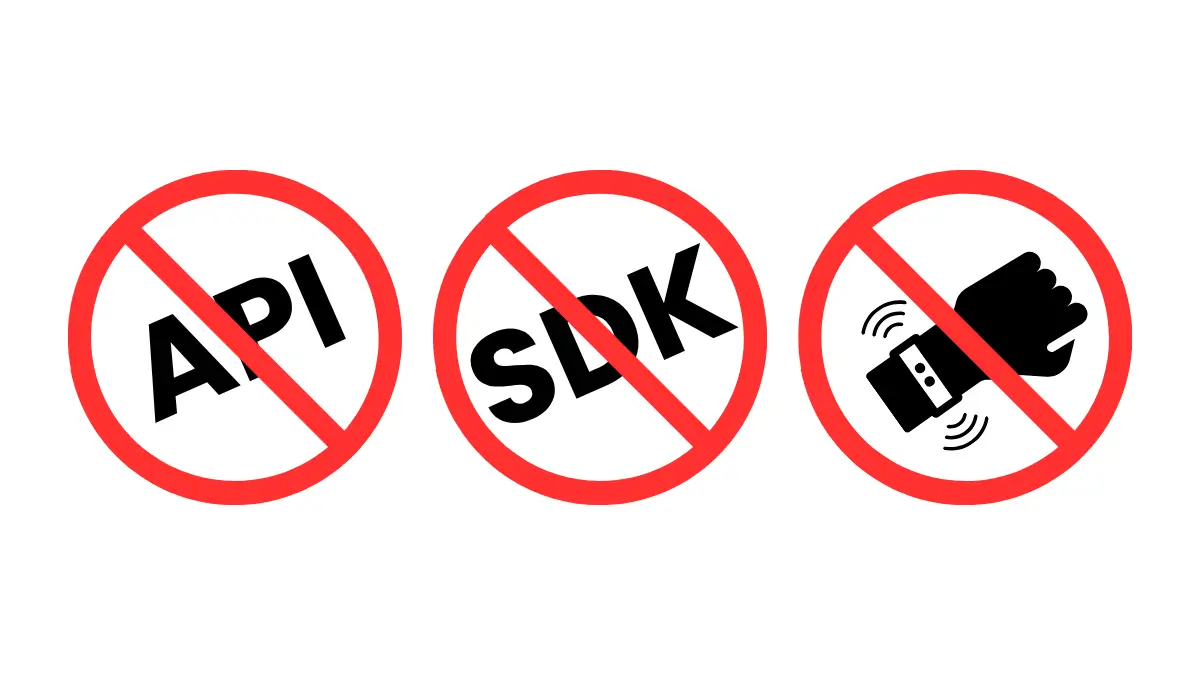
Hover OS is the world’s first gesture-based operating system for ambient computing that supports current web development standards, ensuring instant usability and accelerated time-to-market.
The Integrated OS Core
Hover OS is an Integrated Operating System (IOS) built to be the unified multimodal kernel for ambient computing, designed to run efficiently on multiple compute platforms, starting with x86 for enterprise applications and ARM for low voltage or lower cost edge applications.
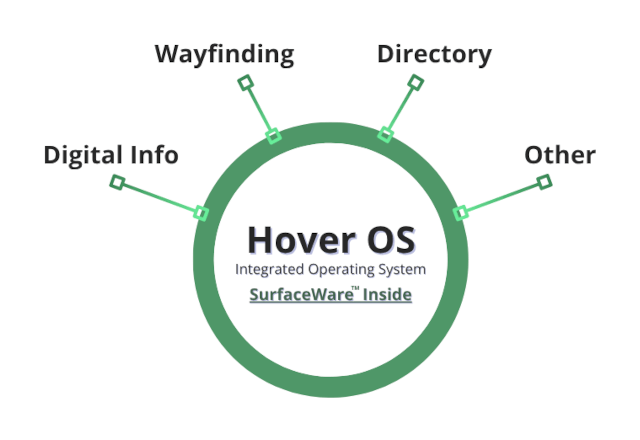
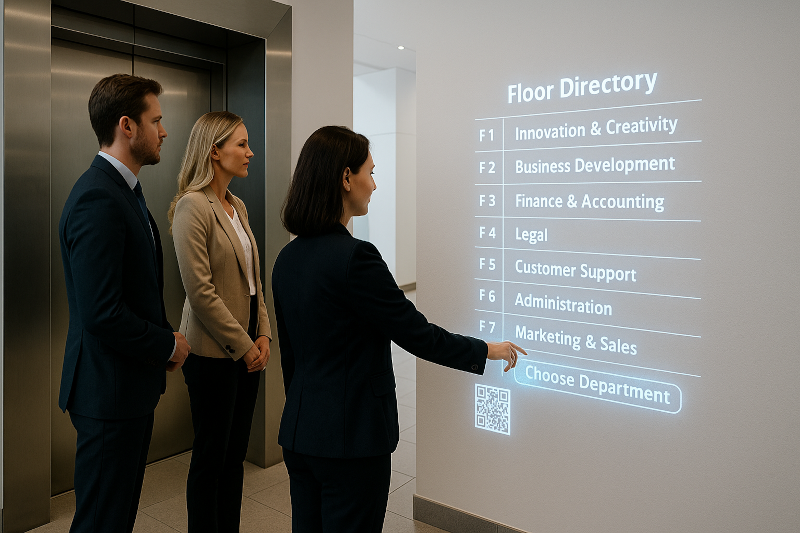
SurfaceWare™ Natural User Interface (NUI) Integration
SurfaceWare Core: The proprietary physical CV AI technology embedded in the OS kernel that transforms any surface like walls, floors, tables or architectural elements into a functional, interactive display. (For detailed technical specifications, please see our dedicated SurfaceWare Technology Page.)
- Algorithmic CV Analysis Pipeline: SurfaceWare’s non-neural network algorithmic pipeline (Spatiotemporal Signal Validation, Kalman filtering, homography matrix estimation) is compact, fast, and efficient, ensuring high-fidelity, low-latency gesture interpretation in diverse environments.
Integrated Multimodal Input
Hover OS unifies the most natural human inputs at the OS level, abstracting the complexity away from application developers:
- NUI Gesture Interface: The system processes touchless hand movements (point, scroll, pinch, pan) into standard OS commands.
- Voice Control: The architecture includes native support for integrated voice interaction, enabling users to issue commands and queries naturally.
- Browser Access: A proprietary secure browser acts as the primary content interface, enabling seamless, secure access to existing web apps and content by URL.

Intuitive User Experience and Feedback
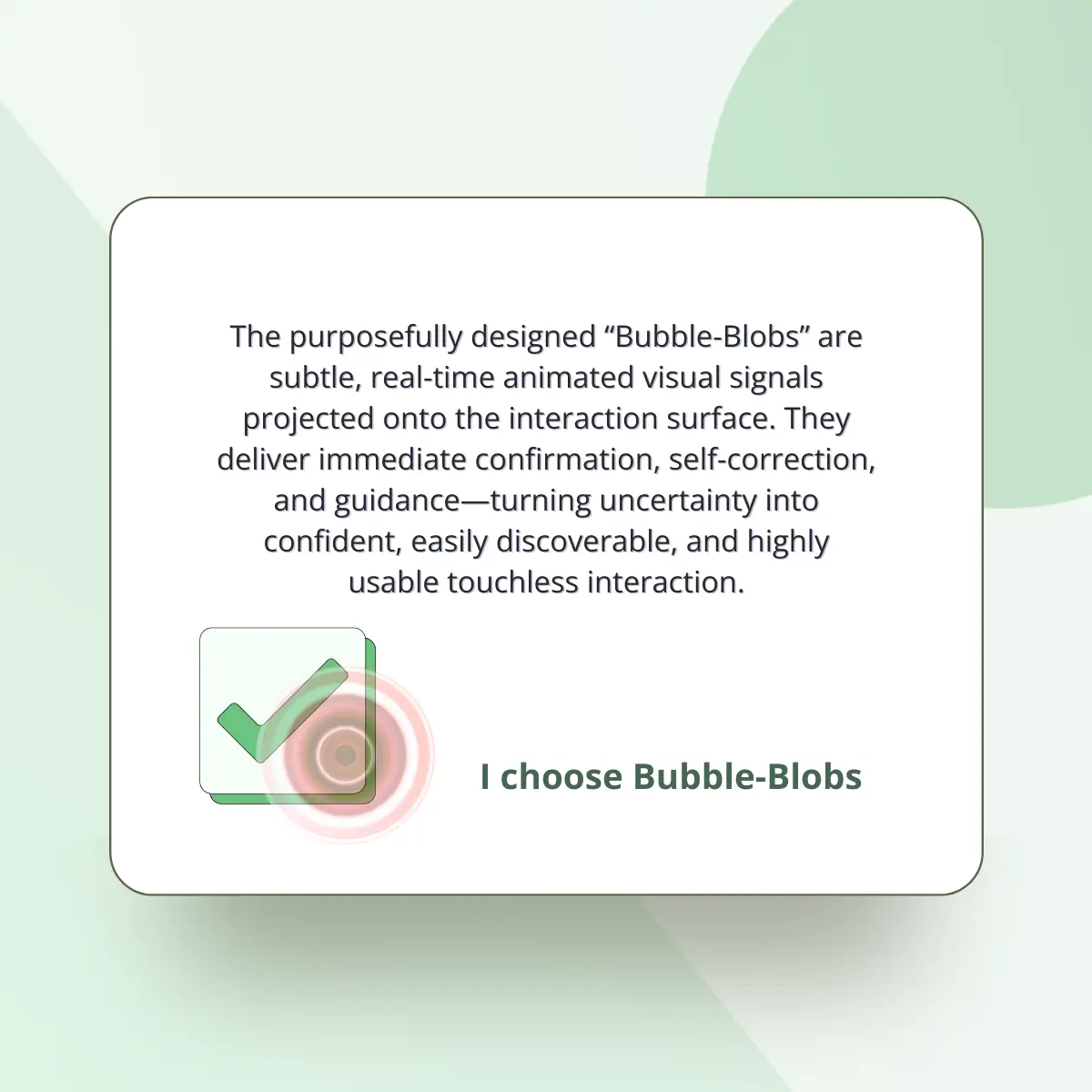
The purposefully designed user feedback system is subtle, effective and enables an immediately learnable user experience. The “Bubble-Blobs”, unlike a mouse pointer, are intuitive, real-time, animated visual signals and feedback directly projected onto the interaction surface in concert with your gestures. This unique UX feature provides immediate confirmation, self-correction, and guidance, transforming user uncertainty into confident control and making the touchless interface easily discoverable and highly usable.
Enterprise-Ready and Channel Friendly
Hover OS is destined to become the standard OS for ambient computing, and its immediate focus is on enterprise applications and specific verticals where touchless interaction provides exponential ROI and solves critical operational needs.
Key Vertical Applications
(Big, Fast, and Easy Interfaces)
Healthcare
Pain Point Solved
High contamination risk from touchscreens and physical devices.
Hover OS Solution
Sterile interfaces for patient check-in, wayfinding, and touchless data access for medical professionals.
Industrial / Manufacturing
Pain Point Solved
Workers wear heavy gloves; need hands-free access in harsh environments.
Hover OS Solution
Glove-compatible interfaces for hands-free ERP access, task lists, and inventory management on any surface.
Public Interactive Display, Digital Out Of Home
Pain Point Solved
Screen wear-and-tear, high maintenance costs, hygiene concerns.
Hover OS Solution
Touchless, engaging wayfinding, real-time information displays, and interactive signage, reducing maintenance costs by up to 85%.
Coming soon: Partner Portal and Client Portal
Complete on-line services to help you manage your fleet of devices and to provision new installations.
Ecosystem Monetization and Future Value
Hover OS’s web-native and hardware agnostic platform provides for rapid development and deployment, driving immediate revenue through As-a-Service (MRR) licensing for channel partners and creating significant future value through ecosystem monetization:
- Ecosystem Opportunities: With Hover OS as the unique gesture-based computing platform, follow-on applications and products can be offered to further expand your business mirroring the platform success of companies like Apple and Microsoft.
- Data and Insight Products: The SurfaceWare Central cloud portal (coming soon) provides aggregated analytics (customer behavior insights, usage patterns) that can be offered as data products for external consumption by ISVs and clients.
Roadmap to Ambient Computing
Hover OS is fundamentally positioned to define the next computing era, ambient computing. Our roadmap is focused on expanding the multimodal kernel to capture the entire spectrum of natural interaction:
Platform Foundation
Focus
Enterprise MRR, Web-Native App Support, Standard Gesture Interface
Key Roadmap Expansion
Full support for natural gestures (NUI), integrated voice control, and browser-based access for web content.
Ambient Standard
Focus
Ecosystem Monetization, Full Multimodal NUI
Key Roadmap Expansion
Expansion to native applications (addressing specialized app needs), and advanced natural interface inputs including greater fidelity in body language, facial expression, and deep environmental context.
Our mission is to enable humans to interact with digital assets in the same way we communicate with each other.
For Integrators and Solution Providers
Transform your hardware expertise into high-margin Physical AI solutions. Join the Hoververse AI Partner Program today.
For IT and Product Leaders
Future-proof your organization. Contact us for a consultation on deploying Hover OS for your high-value enterprise applications.